When the Measure Becomes the Target: Why the Job Market Feels Broken

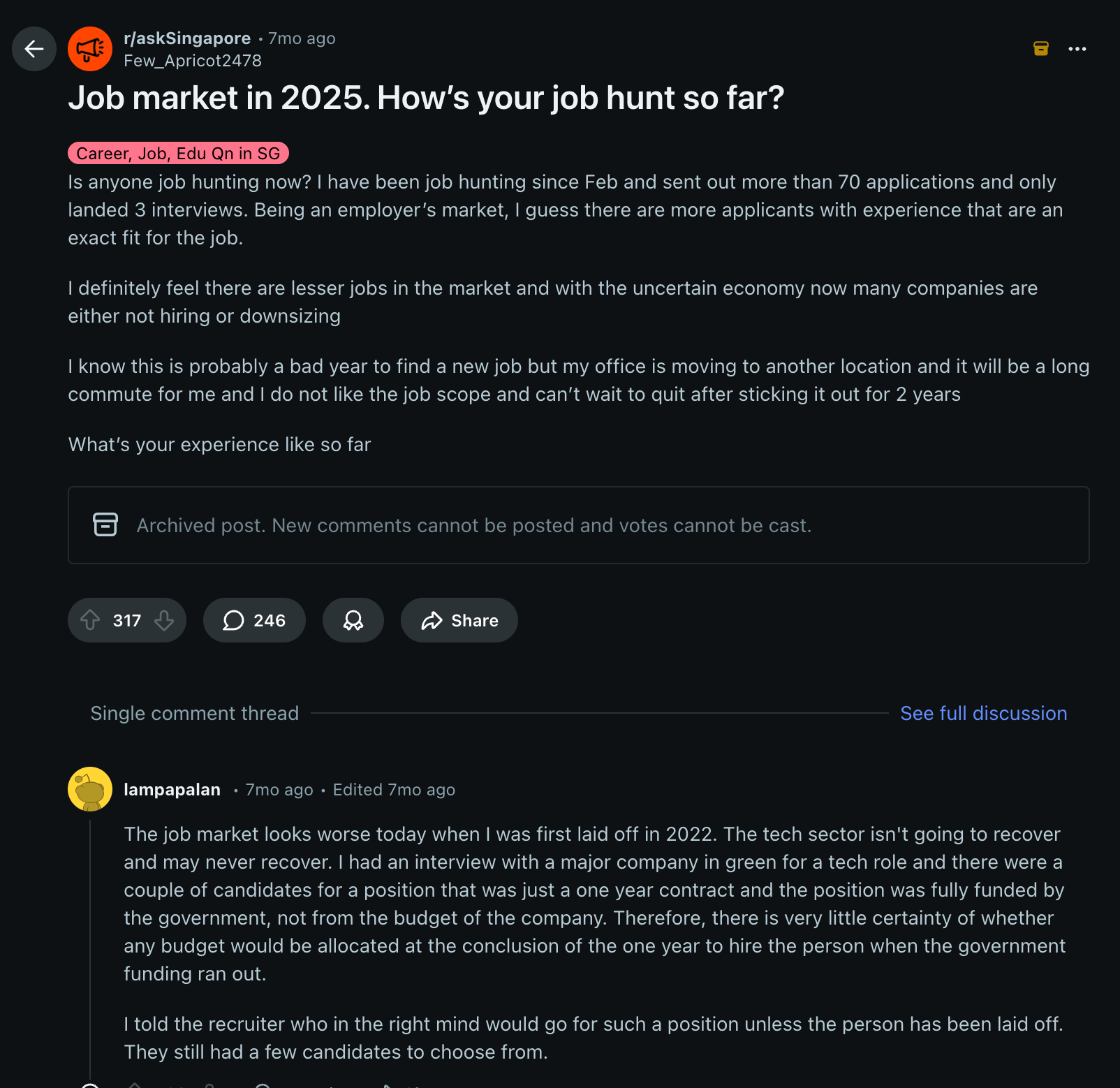
People are always talking about jobs, or rather the lack thereof. People are angry. They feel the world has promised them a contract, study hard, get a degree, get a job, that it is no longer honouring.
I suspect the root of the problem is a classic case of Goodhart’s Law: “When a measure becomes a target, it ceases to be a good measure.”
We have spent so much time optimising for "jobs" (both as individuals and as a nation) that we have forgotten what a job actually is. And that focus is producing some unintended side effects.
The Proxy Problem
What is a job (to me)? Stripped of the sentiment, it is a transaction. You trade your time and skill for money. A job offer is a signal that a business values your output more than they value the cash they have to part with.
But when you make "getting a job" the target, you stop focusing on value creation and start focusing on the signal.
Students optimise for the degree, not the knowledge. They chase internships to fill a resume, not to learn the craft. They operate on the assumption that Degree == Job.
Mid-career professionals fall into a similar trap. They flock to up-skilling courses, often funded by schemes like SkillsFuture, collecting certifications like boy scout badges. They hope that a two-week certificate validates a career pivot. They operate on the assumption that Credential == Competence.
In both cases, they are optimising for the employability signal (the resume line) while the market is looking for the value signal (the ability to do the work).
The Distortion Field
The government faces the same trap. Their metric is "jobs created." This is a sensible metric for a politician, but it distorts the reality for the worker.
The Economic Development Board (EDB) does a great job bringing companies to Singapore. They offer grants and tax breaks, often with the condition that the company must hire locals.
Ideally, the company hires locals because they are the best fit. But incentives change behaviour. The grants distort the price. They often make it rational for a company to hire a "good enough" local at a premium salary, rather than fighting for top-tier global talent.
This looks like a win-win. Us Singaporeans get a high salary, the company gets a tax break, and the government gets a statistic to publish.
But there is a hidden cost.
False Positives
The cost is ignorance.
When you are hired partly because of a policy incentive, the market feedback loop is broken. You don't know how much of your hiring was due to your skill and how much was due to the grant.
You receive a signal of market validation: "You were hired. You are good enough."
Because you receive this signal, you stop feeling the urgency to improve. You feel secure. You have no idea that your employment is being propped up by a mechanism other than your own ability to generate value.
Eventually, the grants change, or the market shifts. When that happens, the person who thought they were safe is suddenly unemployable. They weren't protected; they were sedated.
The Reality Check
I know this because it happened to me.
As a fresh graduate, I landed a software engineering role at TikTok. I was proud. I assumed I had beaten the competition purely on merit. It wasn't until I started working alongside colleagues from the global talent pool that I realised the gap.
I was lucky. I had a manager who gave me harsh, honest feedback. Without that intervention, I would have continued coasting on the belief that I was "TikTok caliber" simply because I held the title, treating my employment as a permanent validation of my skills rather than a temporary opportunity to catch up.
The View from the Hiring Desk
Now that I have done work in a startup and have an input in hiring decisions, I see the math from the other side.
There is a statistical trap we fall into. When we compare ourselves to engineers from the US, India, or China, we often say, "We are just as good as the average there."
But a company hiring globally isn't hiring the "average." They are hiring the top 1%—the self-selected elite who are hungry enough to compete on a global stage.
The business doesn't care about fairness; it cares about output.
- The Skill Ceiling: In hubs like San Francisco, the exposure to massive scale creates a technical depth that is hard to replicate locally.
- The Velocity: It is not just about hours worked. It is about intensity. Engineers from hyper-competitive markets often solve problems with a velocity that feels foreign to us.
It is not that Singaporeans are incompetent. It is that we are expensive.
When you strip away the government grants that subsidise our salaries and compare purely on Value Created per Dollar, the local hire is rarely the optimal choice. The grants bridge that gap. This is good for our bank accounts in the short term, but it blinds us to our true position in the global hierarchy.
The Path Forward
I don't write this to blame the government or self-hating Singaporeans. All parties (politicians, companies, and workers) are acting rationally based on the incentives they face.
But for the individual, relying on these incentives is dangerous. The "Job" is the wrong target. It is a lagging indicator.
The only safe target is Competence.
If you can create value, you will always be able to trade it for money. But if you only know how to get hired or if you only know how to game the proxies, you are at the mercy of the ones printing the grants.
We are not owed a living. The bubble of protection creates a distorted reality, and the only way to survive when that bubble pops is to ignore the false signals of "employment" and focus entirely on the real signal of "value."
Disclaimer
I formed my opinions through my conversations with friends, colleagues, and employers. I may be in a bubble of my own, so please tell me if I am wrong. There are no statistics or evidence to prove my point, only from my observations of my perceived reality.